Have you ever started on an adventure and wondered where it would take you? Did you wonder if anyone would be excited to go with you? Many of these grand adventures take place through marriage, family growth, and career choices. The mystery of the unknown is exciting, but it leaves you wary of the road ahead.
I recently set out on this kind of adventure. God has given me the privilege for the past four years to teach a ladies' Bible study. While diving into Scripture is an adventure on its own, I never quite worried about where it was going to take me like this past study did. I had every intention of leading a six-week Bible study through the Old Testament that would lead the women in my church into Easter. I found the perfect book, but when it came time to order it, it was out of stock and would be for seven months.
The task of finding a new study that fit my vision was nearly impossible. After weeks of research, only one study fit the current timeline and had the potential to meet my criteria. It was a study through Numbers.
I was sure there would be unease and a lack of interest among the women. I was very reluctant to take this journey, but God revealed himself in the most intimate and amazing ways. The adventure of the book of Numbers revealed Jesus in every single chapter.
Though I had seen God’s beautiful revelation throughout the book, the concluding chapters of Numbers gave me pause to wonder how I would find Jesus through a travel log and land boundaries. It was in the heart of these chapters, specifically chapters 33 and 35, that drove home the point that all of Scripture, even the most obscure, points to Jesus and is fulfilled in Jesus.
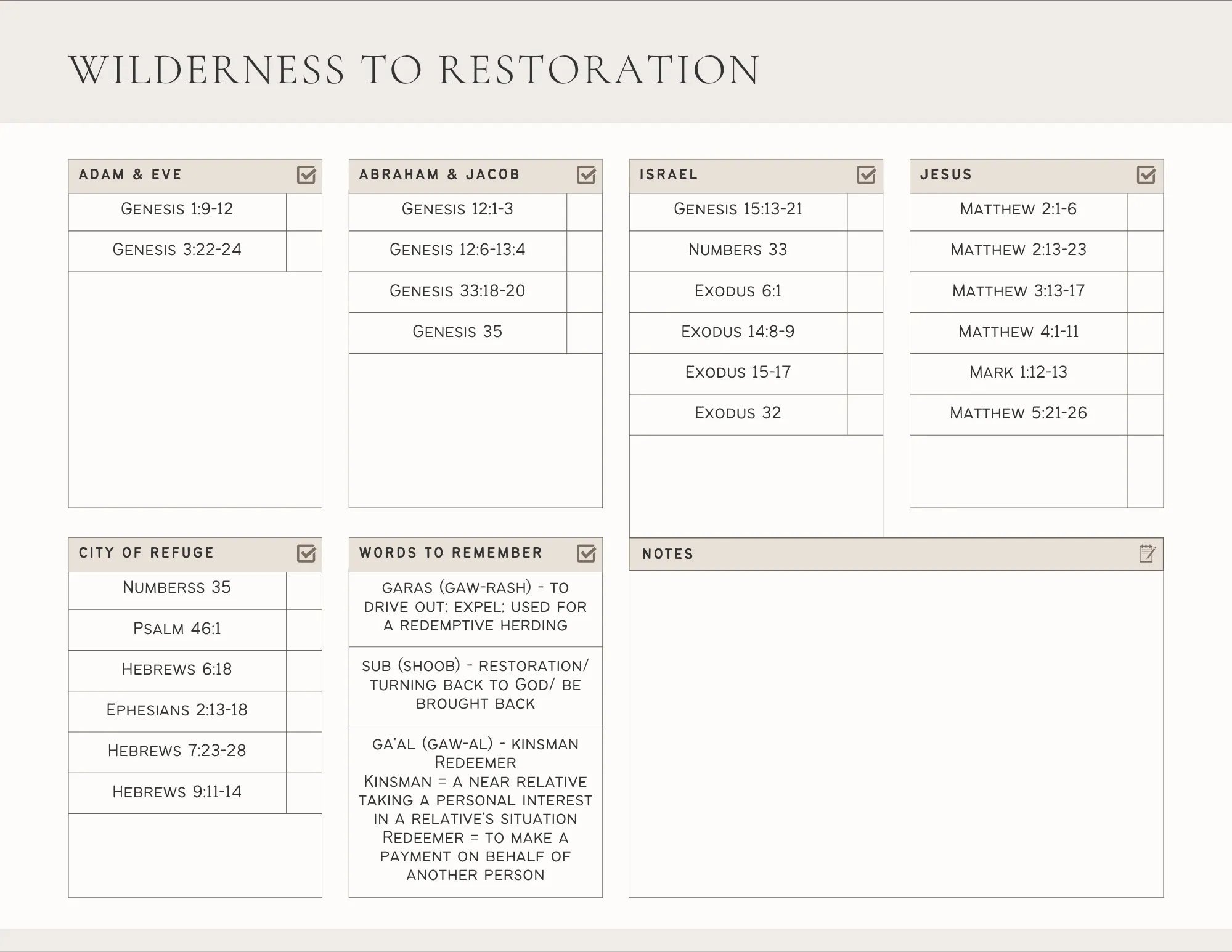
Numbers traces the journey from wilderness to restoration, but the first wilderness story began long before Moses entered history’s scene. The story of wilderness to restoration begins in Genesis.
The First Wilderness
In the very beginning there was nothing but God. Into this nothingness, God breathed space and life. One of the very first spaces God created was separating water from dry land. This dry land was the first barren wilderness that God quickly transformed into a fruitful garden (Gen. 1:9-12).
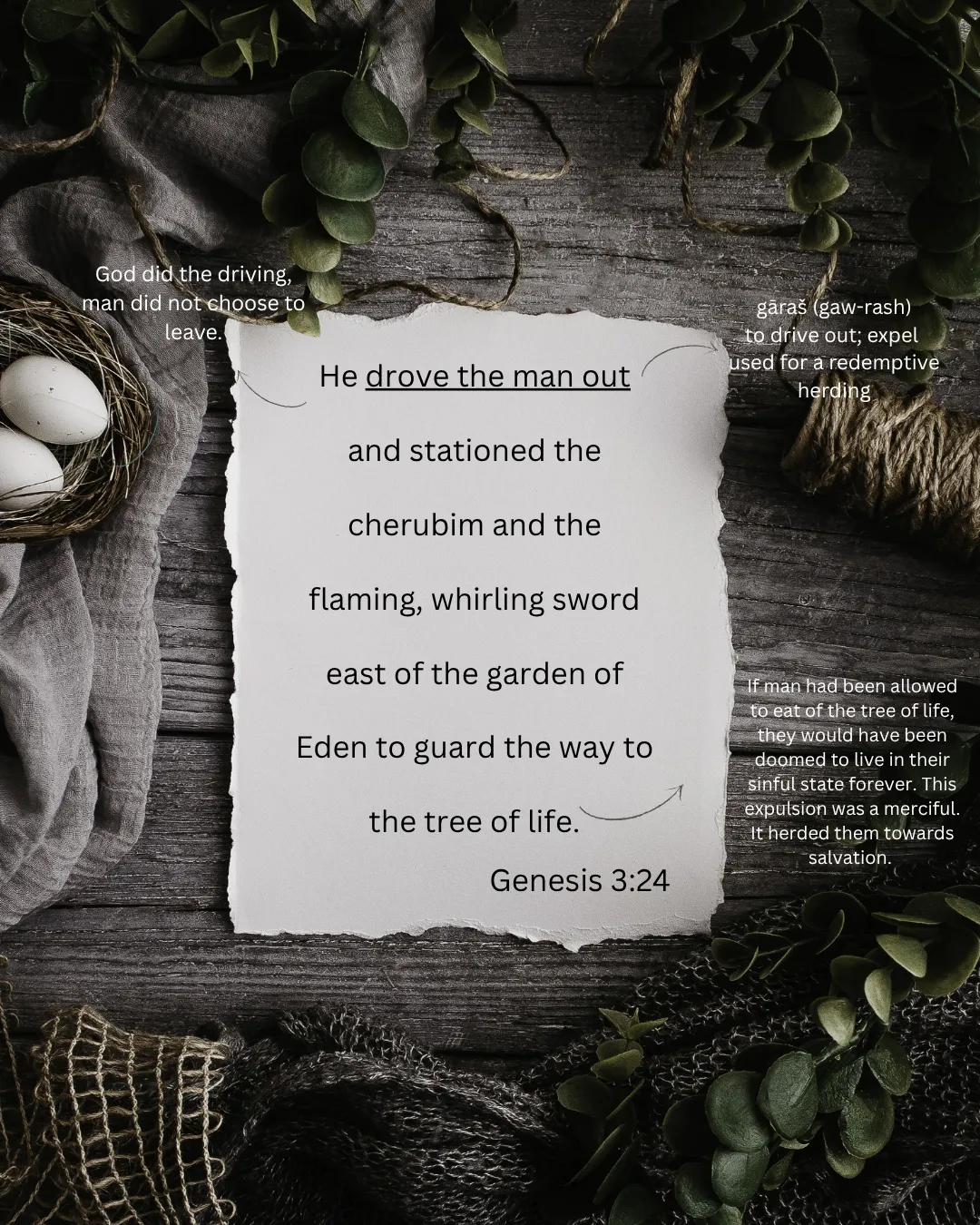
Adam and Eve were placed within the garden to have a personal relationship with God. Unfortunately, this temple garden did not last very long. Their sin could have no place in the presence of God. In order to protect them from eating of the Tree of Life and living in their sin forever, God “drove the man out” (Gen. 3:22-24). This driving out is an expulsion from God’s presence. It was also a redemptive herding. In driving man out of Eden and away from eternal slavery to sin, God was moving them towards restoration.
The remainder of Scripture is all about man being expelled from sin’s slavery, herded into redemption, and being brought back to God.
A Family of Promise
God chose to use one family to embody this story of expulsion, herding, and restoration. Abraham was called out of his homeland, a place void of worshiping the true God. He was herded into a land of inheritance. This was done so that Abraham could receive and bring about restoration through the Messiah (Gen. 12:3).
Abraham was led right into the heart of the Promised Land God said he would give to Abraham’s offspring (Gen. 12:6-13:4). He began his family’s journey in the sanctuary God provided, much like Adam and Eve did. It was within the middle of God’s Promised Land that God foretold that Abraham’s family would be brought into a foreign land of bondage. After four hundred years, they would begin their journey back to receive their inheritance (Gen. 15:13-21).
Abraham’s grandson, Jacob, eventually settled his own family in the heart of Canaan (Gen. 33:18-20, Gen. 35). God used the expulsion of Jacob’s youngest son, Joseph, into Egypt as a slave to bring the whole family out of the land of promise and into the country that would enslave them for four hundred years (Gen. 45:25-28). Israel remained in the barren land of slavery until God chose the time for them to be redemptively herded out of Egypt (Ex. 6:1).
Numbers 33 traces Israel’s journey from expulsion, through redemptive herding, to the cusp of receiving their restored inheritance.
Stages of Israel’s Journey:
- The tenth plague swept through Egypt, killing every firstborn male who was not covered by the blood of the Passover lamb (Num. 1-4, Ex. 11-13).
- Israel stepped out in faith and followed the Spirit through the parting of the Red Sea (Num. 33:5-8, Ex. 14:8-9).
- Israel rebelled against God on their wilderness journey: grumbling about food (Num. 33:11, Ex. 16), complaining and testing God (Num. 33:14, Ex. 17), and worshiping a false god (Num. 33:15, Ex. 32).
- Their rebellion and lack of faith caused ten spies to encourage the whole nation to disobey God and turn away from the Promised Land, resulting in severe consequences (Num. 33:17-18, Num. 13-14).
- The remainder of Numbers 33 traces forty years of wilderness wandering. After forty years, a new generation rose up who faithfully followed God into the Promised Land and received the promised inheritance.
Israel’s embodiment of man’s journey from wilderness to restoration is not perfect. In fact, it is one huge mess, but that is exactly the story God chose to use in order to reveal that man cannot save himself. Without God, there is no redemption or restoration.
Where Israel Failed, Jesus Prevailed
Where Israel failed, Jesus perfectly completed the journey for all mankind.
- Expulsion: Jesus was born in the city of Bethlehem within the heart of the Promised Land (Matthew 2:1-6). He was then driven out of the land into Egypt. Once those who wanted to kill him were dead, God called Jesus back out of Egypt and into the Land (Matthew 2:13-23).
- Identification: At the beginning of Jesus’ ministry, he stepped into the water of baptism in order to participate in repentance (for sins he didn’t have), surrender, and obedience, leaving an example and identifying with mankind (Matthew 3:13-17).
- The Wilderness: The Spirit drove Jesus into the wilderness in order to face the same three temptations that Israel faced: providing bread of his own accord, testing God, and worshiping Satan. Jesus passed every single temptation.
The story of Scripture was always laying the stage for Jesus to step in and redeem the world. Every promise made, prophecy foretold, and king raised up was in preparation for the Son of God to fulfill what no man could. He was faithful, obedient, and sinless. Jesus did this in order to make provision for people who could never save themselves.
The final hours of Jesus' life followed the same pattern of garden, expulsion, redemptive herding, and restoration. He began in the Garden of Gethsemane, only this garden wasn’t one of beauty and joy; it was filled with intense prayer and pleading. He was then expelled from the garden by betrayal. The guards seized him and led him away.
The Ultimate Restoration
Jesus was redemptively herded to the cross. Salvation requires a blood sacrifice. God sacrificed the first lamb for Adam. The Passover lamb was sacrificed for Israel. Now, the Son of God—our great High Priest, Kinsman Redeemer, and perfect Lamb—would be sacrificed in order to freely invite us into a heavenly inheritance.
Jesus hung on the cross and uttered his final words, “It is finished.” All of this occurred so that Scripture might be fulfilled. Not only was your personal salvation accomplished on the cross, but every promise, prophecy, and hope pertaining to life, sacrifice, and restoration to God was fulfilled in that moment.
Restoration was finally completed in Christ’s resurrection and ascension. The Spirit is able to reside with man and will not be removed from believers. Final restoration in heaven is yet to come, but it is sure. This is why we can find Christ on every page of the Bible, because all of Scripture maps Christ’s fulfillment of our journey from wilderness to restoration.