One of my favorite things to do when I open the Bible is to map out what a passage says about God. Finding different names, characteristics, actions, and metaphors for God makes the Bible transform from a black-and-white book to a real, tangible letter from my God. One of my favorite chapters that reveals the person of God is Psalm 145.
David, the Shepherd King of Israel, litters his final recorded Psalm with praise for who God is and what He does.
📖 The Character of God
Quick reference guide to God's nature in this Psalm:
- The King & The Great: v. 1, 3
- The Creator of Wonders: v. 4, 5, 6
- The Gracious & Compassionate: v. 8
- The Everlasting Provider: v. 13, 14, 16
- The Near & Saving God: v. 18, 19, 20
🎨 The 10 Forms of Worship
David introduces us to ten different forms of worship. The English language is unable to fully express the true nature of worship here. So, we will break each form down according to it’s origional Hebrew meaning to understand the word further.
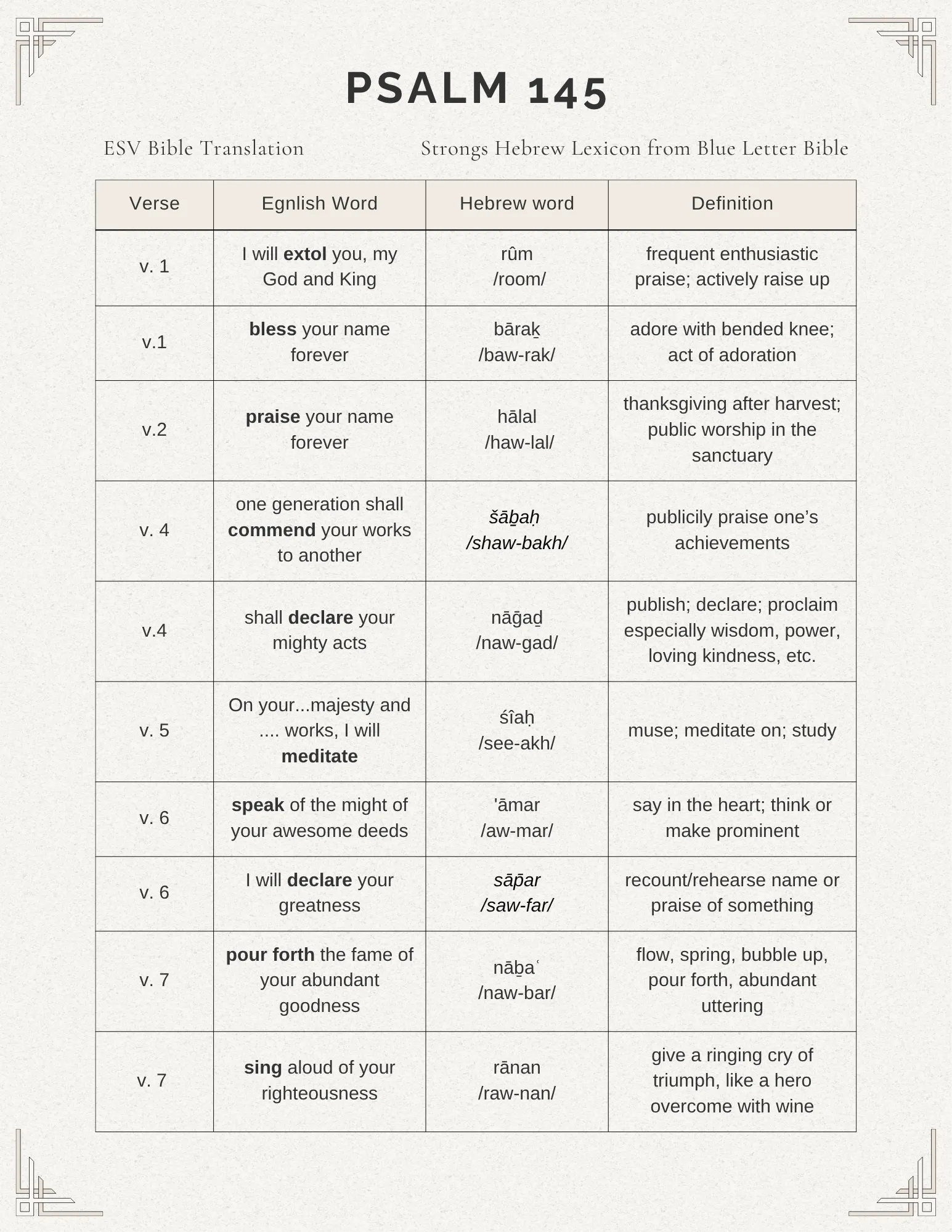
Worship as an Active State
Worship, according to David, is to be an active state of being. We cannot fully embody worship if we are restrained to personal or communal alone. Worship is meant to begin in the heart and then flow out into communal living with other Christians.
The Old Testament Pattern
In the Old Testament, corporate worship occurred twice a day in the temple (Exodus 29:38-39). Even those who did not attend the temple service knew that in the morning and the evening a lamb was being sacrificed and praise was being offered.
The New Covenant Pattern
After Christ’s once-for-all sacrifice, worship shifted. Acts 2:46-47 shows worship happening daily—in the temple, around the table, and in homes. Our daily lives are meant to be an amplification of this communal worship.
The Call of the Faithful
Those who are faithful to God will bless God and speak of the glory of His kingdom. They will declare God’s might, inform all people of His mighty acts, and speak of the splendor of His kingdom. A godly person follows David’s example in verses 8-13 to teach who God is, what He has done, and what He has promised to do.
This occurs when we allow the Word of God to dwell richly in us. It results in "pouring forth" teaching, admonishing, and thanksgiving (Col. 3:15-17). Our conversation ought to distinguish us from the world—not just because we avoid negativity, but because our speech bubbles with outward praise.
A Closing Blessing
May your worship today begin in the quiet places of the heart but never end there. As it overflows into your relationships and your community, may your mouth become a wellspring of praise, continually declaring the goodness of God to all who hear.
(For further word study, check the Strong’s Lexicon on blueletterbible.org)