
I enjoy peculiar information and bizarre facts, and so do most of my family. As a teenager, my parents enjoyed taking my siblings and I out for breakfast. It was not uncommon to pass the time by seeing who had the most random fact. These could range from computer knowledge to sports stats to actors to the Bible. Nothing was off the table. Where my family calls this good fun, my husband calls it useless information.
The book of Numbers is often approached as a book of useless information. Sure, there are a few good historical narratives like the 12 spies scouting Canaan and a talking donkey, but chances are, if you didn’t give up on your "Bible in a year" plan in Leviticus, Numbers is the one that tripped you up.
This is due to what feels like useless information. Things like genealogies, laws, sacrifices, and an account of the wilderness that includes every difficult name to pronounce in the known world at that time don’t seem worth the investment.
In the middle of these less-than-desirable chapters, God gives us Numbers 19. I would dare argue that this is the most Gospel-rich passage in all of Numbers.
The Statute of the Red Heifer
“Now the Lord spoke to Moses and to Aaron, saying, “This is the statute of the law that the Lord has commanded: Tell the people of Israel to bring you a red heifer without defect, in which there is no blemish, and on which a yoke has never come. And you shall give it to Eleazar the priest, and it shall be taken outside the camp and slaughtered before him.
And Eleazar the priest shall take some of its blood with his finger, and sprinkle some of its blood toward the front of the tent of meeting seven times. And the heifer shall be burned in his sight. Its skin, its flesh, and its blood, with its dung, shall be burned. And the priest shall take cedarwood and hyssop and scarlet yarn, and throw them into the fire burning the heifer.
And the one who gathers the ashes of the heifer shall wash his clothes and be unclean until evening. And this shall be a perpetual statute for the people of Israel, and for the stranger who sojourns among them.” — Numbers 19:1-6, 10
A Pearl in the Narrative
Numbers 19 zeroes in on the purification ritual for Israel. It’s easy to lose this pearl amongst the more intense narrative of Numbers, but stick with me. This purification ritual was a necessary sin offering for uncleanness and impurity. It made provision for the one thing that truly separates us from God forever: Death.
Death is the ultimate separation between God and man. It was the chief consequence of sin in Eden. No one can defeat or avoid death. So God had to make provision for it.
How This Sacrifice Was Different
The purification sacrifice was different from the typical sacrifice:
- The Animal: The sacrifice was an unblemished red cow that had never been yoked.
- The Location: It was not to be sacrificed within the tabernacle like most of the other offerings; rather, it was to be brought outside of the camp.
- The Blood: While most offerings had their blood spilled apart from the sacrifice, this cow was to remain whole. The blood was a crucial part of the sacrifice.
Shadows of the Savior
The unblemished red cow brought outside the camp represents Jesus. The only perfect man to walk the earth was brought outside of the city of Jerusalem to be killed for the sins of the world. His body was not broken. His blood was shed upon the cross itself.
Accompanying the heifer were three additional items: cedarwood, hyssop, and crimson yarn.
- Cedarwood: Cedarwood was known for its ability to resist disease and rot. This wood, burned with the cow, represented the cross that Christ would bear and be slaughtered upon.
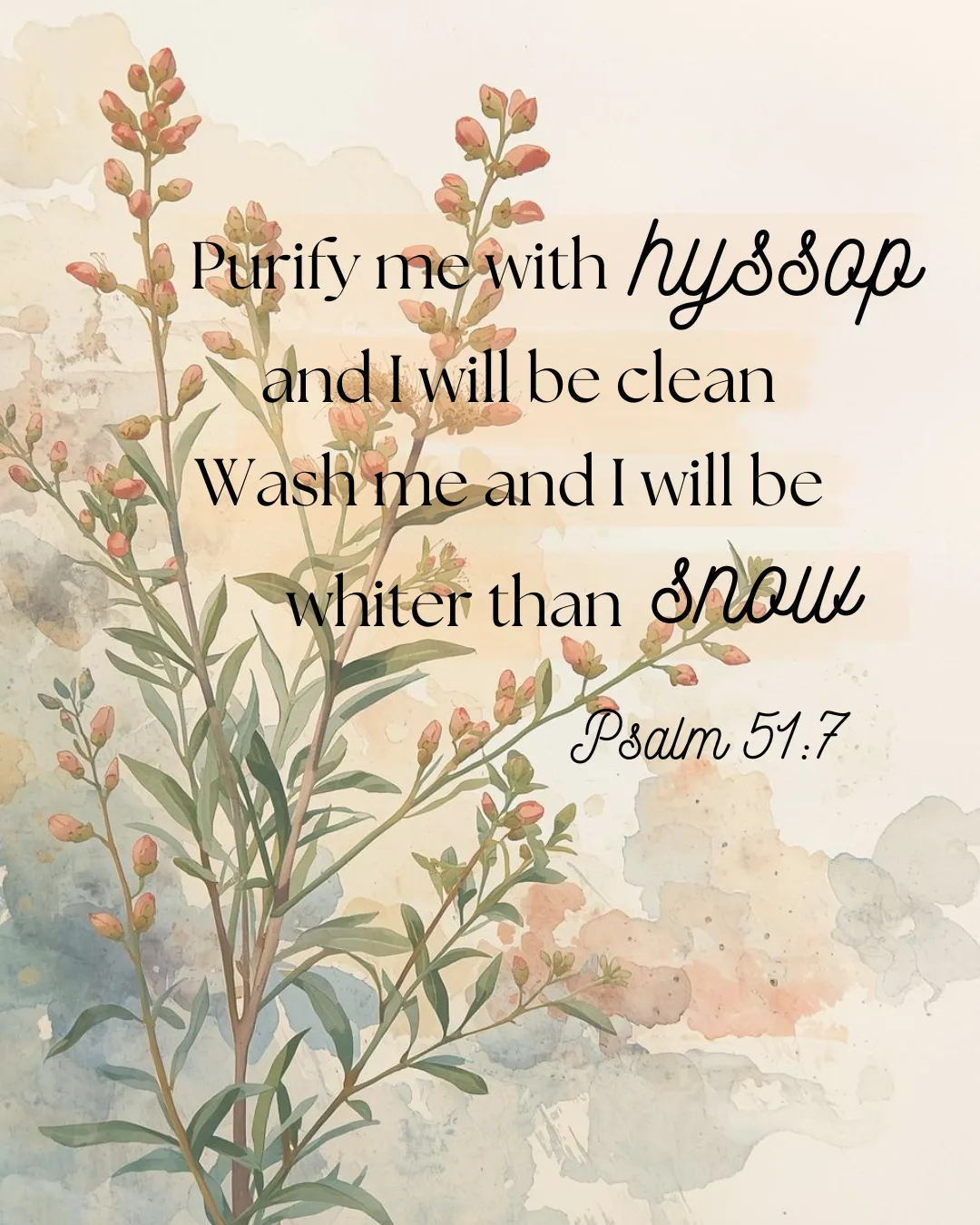
- Hyssop: Hyssop was associated with cleansing. It was included in the ritual to cleanse lepers. David associated hyssop with cleansing of the heart: “Purify me with hyssop, and I will be clean; wash me, and I will be whiter than snow” (Psalm 51:7). Jesus himself received a hyssop branch while he was on the cross. After receiving the hyssop, he declared, “It is finished,” and gave up the spirit (John 19:28-30).
- Crimson Yarn: The crimson yarn used to bind the cedarwood and hyssop branch can be traced for its symbol of salvation throughout Scripture. The tabernacle veil and priests' garments were crimson. Rahab’s cord, which she hung outside of her window, was crimson. On the journey to the cross, the Roman soldiers mocked Jesus by laying a crimson robe upon his scarred back. Crimson was a visual representation that without the shedding of blood, there could be no forgiveness of sin.
From Death to Life
Numbers 19 concludes by stating that anyone who has been defiled by death must have a clean person dip a hyssop branch into water that has been mingled with the ashes from the purification sacrifice and sprinkle it upon the unclean person.
The unclean person could not reverse the effects of death and could not make himself clean. It is only by the assistance of a clean person and the ritual that one could be made pure. In the same way, no person can save himself from sin and death. It is only through the Father showing mercy, sending Jesus to die on the cross, resurrect, and ascend, and the sending of the Spirit that someone can pass from spiritual death into newness of life.
The Fulfillment in Hebrews
The author of Hebrews ties it all together neatly:
“For when every commandment of the law had been declared by Moses to all the people, he took the blood of calves and goats, with water and scarlet wool and hyssop, and sprinkled both the book itself and all the people, saying, “This is the blood of the covenant that God commanded for you” — Hebrews 9:19-20
The author goes on to explain how Christ came into the world in order to fulfill every law and sacrifice given to Moses. It is through Christ’s once and for all sacrifice that sin has been defeated and death no longer has the victory.
In a book that doesn’t make anyone’s top ten favorites in Scripture, God beautifully laid out his plan for salvation. Not only did he lay out the plan, but he made provision for the people who did not know Christ and could not save themselves.
Thanks be to God for Gospel-rich truth in the middle of Numbers.