“LORD, God of vengeance - God of vengeance, shine! Rise up, Judge of the earth; repay the proud what they deserve. LORD, how long will the wicked - how long will the wicked celebrate? .... The LORD knows the thoughts of mankind; they are futile.”
— Psalm 94:1-3, 11
Psalm 94 displays a crescendo from mourning to praise. In the midst of tumultuous circumstances, the author cries out for God to execute vengeance upon the wicked. The author is overwhelmed by the sin of the world. Injustice creeps around every corner mocking those who try to do right, exalting those who thrive on sin.
If I’m being honest, I look out on the world and my plea is similar to Psalm 94. How long, Lord, will you let evil reign? Don’t you see the pain?
Justice vs. Revenge
God’s vengeance is not like man’s revenge. It is just punishment inflicted as the result of an offense. Every act of God’s vengeance is just. It is intended to bring the wicked to justice and the rebellious to ruin.
The Psalmist cries out for God’s help because the wicked never seem to cease their self-serving ways. The wicked are defiant and proud. They destroy God’s people and afflict them. The weak and disadvantaged are attacked. Every rebellious man acts in ignorance and arrogance towards God.
In response to the wicked, the author almost sarcastically asks the audience if God cannot hear, see, teach or discipline the wicked. He answers these rhetorical questions with “of course God can! He knows everything.” The wicked may think they have the upper hand, but they cannot really get away with defying God.
A Mercy in the Waiting
The author and myself may see injustice reigning, but we do not feel it as deeply as God does. He knows. He sees. It is in his mercy that he is waiting to strike vengeance. Every moment God prolongs punishment is an opportunity for the sinner to repent and turn to God.
The psalmist must have been frustrated with his people’s oppression, but he changes his tone in verse 12. He moves from sarcastic and frustrated to a confident, righteous defiance. He contrasts the rebellious with a blessed man.
“LORD, how happy is anyone you discipline and teach from your law to give him relief from troubled times until a pit is dug for the wicked. The LORD will not leave his people or abandon his heritage, for the administration of justice will again be righteous, and all the upright in heart will follow it.”
— Psalm 94:12-15
According to Job 5:15-18 and Psalm 94:12-13, a blessed man is a person who receives instruction and discipline. God’s discipline gives rest because the one who knows God’s Word and has received his correction understands that wickedness will not prosper. The enemy does not know true rest or victory. Lawlessness does not equal freedom.
Three Pillars of Grace
The gospel packs a powerful punch in verses 16-19. The three things the author praises God for are redemptive in nature:
- Life: God brings help to deliver us from death so we may rest in life. “If the LORD had not been my helper; I would soon rest in the silence of death.” (v. 17)
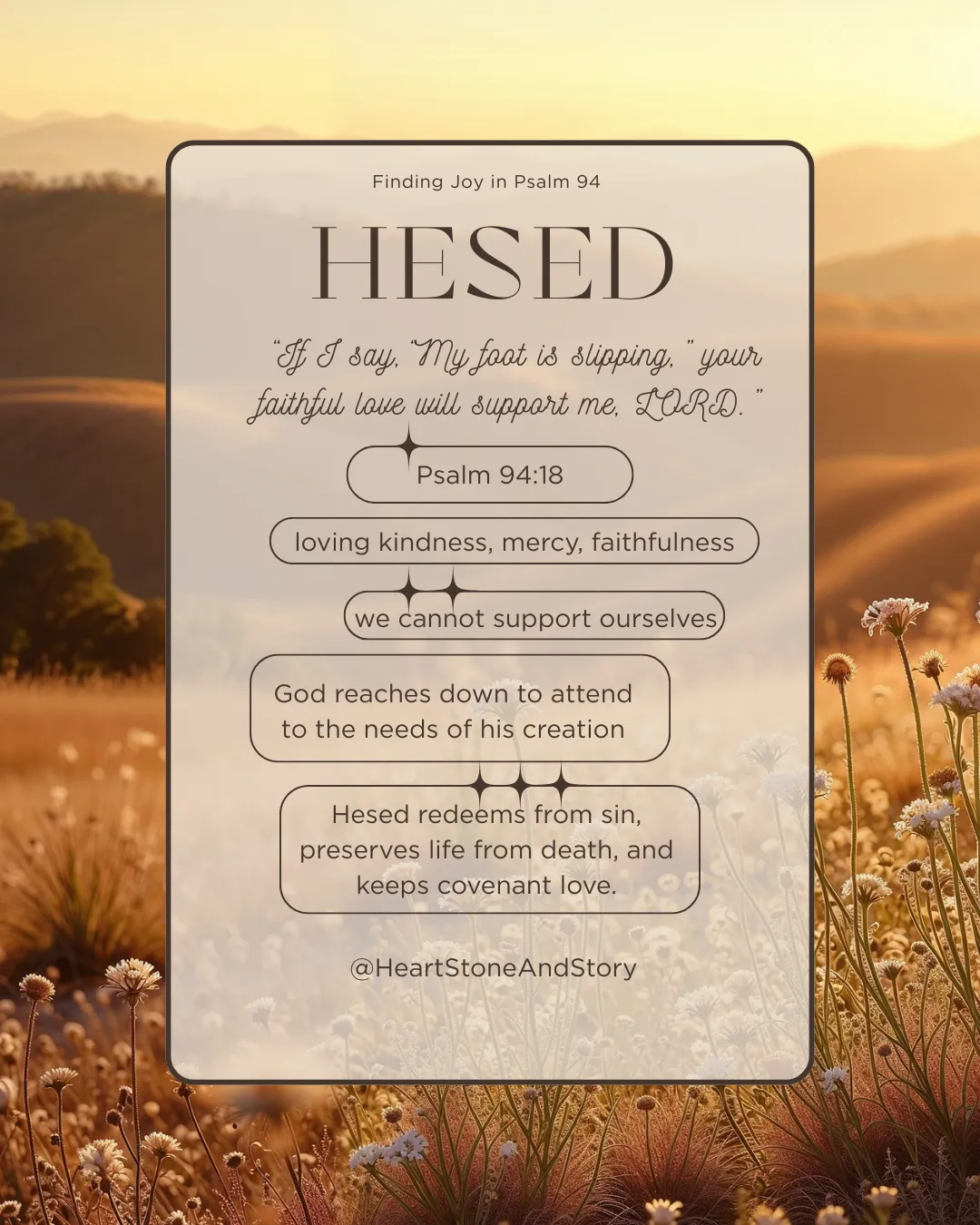
- Support: Through grace, God’s faithful love supports us because we cannot keep ourselves from slipping. “If I say, ‘My foot is slipping,’ your faithful love will support me, LORD.” (v. 18)
- Joy: God’s comfort—which comes from the Holy Spirit—brings joy. He transforms sorrow and striving into an unshakable joy. “When I am filled with cares, your comfort brings me joy.” (v. 19)
The Power of Hesed
The root of redemption is found in verse 18, “your faithful love will support me.” The word for faithful love in Hebrew is hesed. Hesed means the loving kindness of God. The same hesed that sustains the Psalmist in trouble is seen in action in the story of Ruth.
Ruth opens with a family looking for food and help outside of God’s land. While in a foreign land, the sons took foreign wives. Soon, father and sons die, and God’s daughter Naomi is left with two foreign daughters.
Naomi leaves Moab in search of food back home. On her journey she turns to her two foreign daughters-in-law and says, “Each of you go back to your mother’s home. May the LORD show kindness to you as you have shown to the dead and to me. May the LORD grant each of you rest in the house of a new husband.” (Ruth 1:8-9)
Naomi wished for her daughters-in-law to receive God’s kindness so that they may have rest from heartache and trouble. One daughter-in-law returned to her people; the other, Ruth, committed to staying with her mother-in-law. She would make Yahweh her God. She would search for rest within the confines of Yahweh’s law.
Ruth willfully submitted to living as a foreigner in Bethlehem. She went to work to find food so that her mother-in-law could find rest and, in return, God brought rest to her. Ruth 2:19-20 says:
“Her mother-in-law said to her, ‘Where did you gather barley today, and where did you work? May the LORD bless the man who noticed you.’ Ruth told her mother-in-law whom she had worked with and said, ‘The name of the man is Boaz.’ Then Naomi said to her daughter-in-law, ‘May the LORD bless him because he has not abandoned his kindness to the living or the dead.’ Naomi continued, ‘The man is a close relative. He is one of our family redeemers.’”
Boaz chose not to abandon his family or his heritage. He would willingly be their kinsman redeemer and buy them out oftrouble, relieve/comfort their cares, and enter a marriage covenant in order to preserve life.
Conclusion
This loving kindness of God—hesed—is defined very specifically for both Ruth and Psalm 94. Hesed is the loving kindness of God reaching down to attend to the needs of his creation. It specifically brings redemption from enemies and trouble. Hesed redeems from sin, preserves life from death, and keeps covenant love.
We can endure a corrupt world of injustice because the hesed of God gives us rest. His faithful love will never change. He is our rock of protection. We need not fear what the wicked will do because they can never overcome God.
Where have you seen God’s loving kindness redeem your story lately?