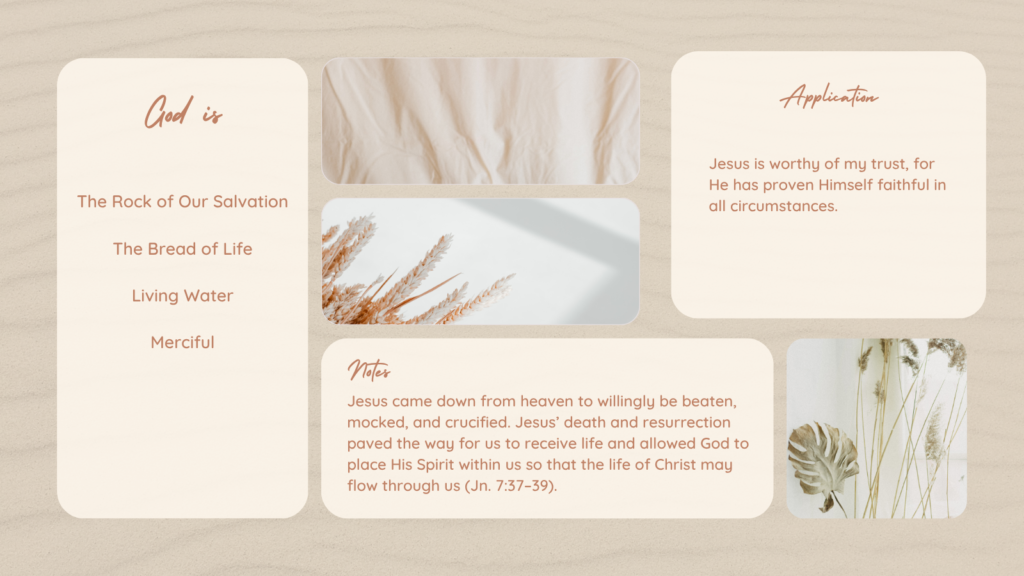
What do bread, water, and a rock have to do with salvation? Exodus 17:1–7 reveals God’s salvation and provision painting a vivid picture of the gospel. Through this narrative God revealed that Jesus himself is the Bread of Life, the Living Water, and the Rock of our Salvation. When we read this wilderness story in light of Christ, it whets our appetite to dig deeper into the Old Testament and discover how God used every part of Israel’s history to reveal His Son.
Israel’s Problem
Three days after Moses led Israel away from the Red Sea, the people faced their first dilemma: they had no water. Moses cried out to God for help, and God answered. God used this moment to lay before Israel a test — much like He tested Abraham — to prove their faithfulness to Him. If Israel would obey God and pay attention to His commands, God promised not to afflict them as He did Egypt, for God is the one who heals (Ex. 15:22–27).
Days later, the Israelites began to complain again because they had no food. Surely, without bread, they would die. God used this moment to once more test Israel’s faithfulness. He provided manna in the wilderness with specific instructions to test whether Israel would obey His commands or not (Ex. 16:1–8). This bread from heaven sustained them along their wilderness journey.
God delivered Israel from Egypt, gave them manna from heaven, and provided sweet water in the desert. However, at the first sign of trouble, the people rebelled. They brought their complaints about having no water to Moses in order to test the LORD. Despite the wonders God had done and the mighty acts He had performed, the people wanted Yahweh to prove whether He was truly among them or not.
Yahweh’s Response
“He worked wonders in the sight of their fathers in the land of Egypt, the territory of Zoan. He split the sea and brought them across; the water stood firm like a wall. He led them with a cloud by day and with a fiery light throughout the night… He led his people out like sheep and guided them like a flock in the wilderness. He led them safely, and they were not afraid; but the sea covered their enemies.” — Psalm 78:12–14, 52–53
God’s power and love shone brighter than the sun to Israel, yet the people still challenged His faithfulness. Israel deserved God’s judgment. Instead of death, God produced abundant life.
God commanded Moses to go ahead of the people. The elders were to join Moses so they could serve as witnesses to the people. Moses was to bring his staff, which he had previously used to facilitate God’s wondrous acts in Egypt. God had used Moses’ staff as a rod of punishment against Egypt; now, He would use that same rod to bring life-giving water.
Finally, God commanded Moses to strike the rock while God Himself stood in front of it. Rather than pour out judgment on Israel as He did with Egypt, God was going to absorb the blow from the rod of punishment. God willingly put Himself in Israel’s place to show His people mercy.

The Rock of Our Salvation
Paul tells us that Israel drank from the spiritual rock that followed them, and that rock was Christ (1 Cor. 10:4). How Christ appeared before the rock and accompanied Israel on their journey is not specifically stated. Whether Paul intended a literal Christophany or a rich typological connection, the message is clear: Yahweh stood before the rock at Horeb to absorb the blow intended for rebellious Israel. On the cross, Christ did the same for us. God himeslf received the rod of punishment so that His people could drink from the river of life.
Many generations later, God promised King David that one of his descendants would be disciplined with a rod of men, but that God’s faithful love would never leave him. This descendant would establish his throne and kingdom forever (2 Samuel 7:12–16). Jesus took the judgment for Israel at Horeb. Later, He came to earth fully God and fully man as the Bread of Life and Living Water in order to be pierced and crushed for our sin so that we might receive life (Isaiah 53:5).
Exodus 17 is a foreshadowing and picture of Christ and the church. Israel deserved to be struck down for their rebellion. Their hardness of heart caused them to test God, yet in His great mercy, God did not strike Israel down as He did Pharaoh in Egypt. Instead, God stood before a rock to receive the blow of Moses’ staff. This caused the rock to burst forth with living water so Israel could receive physical life and be sustained until they reached the Promised Land.
Rocks are dead material. No matter how hard man tries, he cannot force life from something that is dead. Israel’s hope and provision came not from an inanimate object, but from God, who was able to breathe abundant life into a dead stone.
We are like the Israelites, and we are like the rock. We long to be satisfied—to find hope and life—but we seek it in all the wrong places. Without Christ, we are like that rock. Paul tells us in Ephesians 2 that without Christ, all people are dead in their trespasses and sins.
Ezekiel describes people as having hearts of stone (Ez. 36:24–29). In order to receive hearts of flesh and be given the Spirit of life, the punishment for our rebellion had to be paid. Jesus came down from heaven to willingly be beaten, mocked, and crucified. Jesus’ death and resurrection paved the way for us to receive life and allowed God to place His Spirit within us so that the life of Christ may flow through us (Jn. 7:37–39).
How Will You Respond?
Paul warns the church at Corinth that everything in Israel’s exodus and wilderness wanderings occurred as an example for us, so that we will not desire evil things (1 Cor. 10:6). We are warned against idolatry, sexual sin, testing Christ’s faithfulness, and complaining. Show me someone who has flesh and blood, and I’ll show you someone who struggles with these sins.
So, what are you going to do with the Exodus narrative today? Will you treat it as a nice Sunday school story, or file it away among the biblical knowledge you’ve accumulated to visit another day? Or will you heed Paul’s warning and Israel’s example to refrain from evil?
What will you do with Christ today? He has laid His life down in front of you to absorb every blow you deserve for your sin. He offers to satisfy you as the Bread of Life and fill you with His Living Water. He is worthy of your trust, for He has proven Himself faithful in all circumstances.
Thanks be to God that Jesus came down to give life, and to give it more abundantly!